With a bit of delay, I think I should at least honour the new caliber here on my Blog and share some of my thoughts. I’m relying on official press photos and information only but I was able to see a prototype some time ago in real. What many don’t know, developing a new in-house caliber is a huge undertaking, esp. for a relatively small Maison like Girard-Perregaux. It takes many years and many millions of CHF to take a vision of a new caliber to a final product.
Why even bother developing a new caliber many may ask. GP has its workhorse in-house caliber GP3300 and even the GP1800 which was not entirely a new development in fairness. The answer is simple, you cannot stand still, you need to innovate and excite and the old caliber goes back to the 90s development of the GP3000. It has aged, even it aged well, it was time to go back to the drawing board and develop a new generation from scratch.
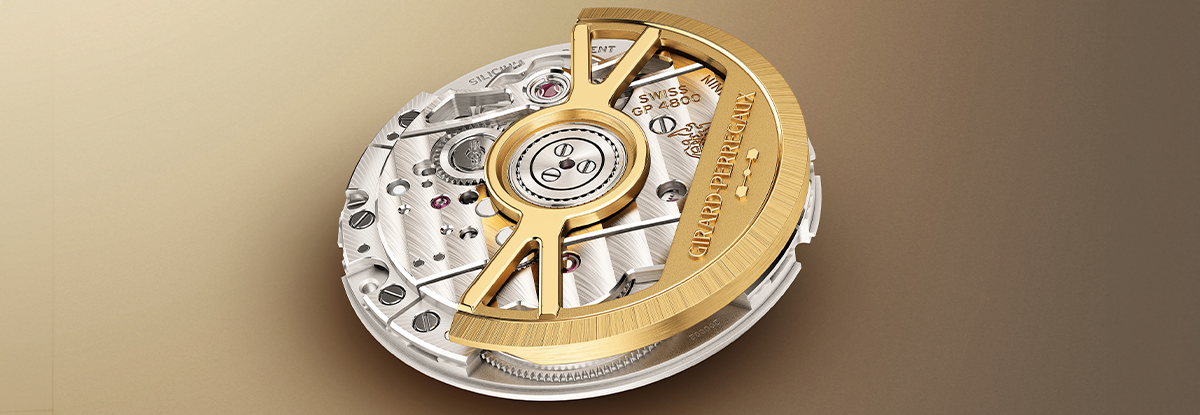
It is not a big surprise that the new caliber has the now quite common bells and whistles such as free-sprung balance, ceramic ballbearings or silicon escapement which every Haute Horlogerie manufacture has up its sleeves. Doing anything less would have been a bit pointless. A lot of focus has been given to the aesthetics of the caliber. I do like the old GP03300 caliber, in fact, much more than the GP01800 in terms of design of the bridges and overall coherent look. Caliber GP4800 has a lot of GP DNA and is in my view a very beautiful design. The marketing spill claims an underlying homage of the GP three-bridge design, but okay, that’s the Marketing folks.
What counts for me is that it is a balanced design. The finishing is par with its peers in the market and you can see a lot of attention to detail. The oscillating weight sports the most significant change. Now frankly, that’s like the paint of a car, visible on top, but not really anything vital to the technology under the hood. Yet, it is a beautiful, half-skeletonised design, I’m happy to see and is pleasing to the eye.
I read on various magazines, forums etc. complains about the caliber being 25.6mm in size, or in other words 11.5 lignes. It is still the same size as the old caliber GP03300, but I doubt very much that this was done so that existing modules like Chronograph can be added. I think there is surely room for an integrated design for a future Chronograph caliber. The idea behind the size is a different one and it goes back again to the overall aesthetics of the caliber.
I’m sure it was a conscious decision to keep the new caliber at the same or similar size. First of all, I don’t think there are many 42mm or larger new models on the horizon, the trend is back to more classic size watches 38/39mm for which this caliber is a perfect fit. Keeping the skill at the manufacture to develop, produce and finish smaller calibers is very important. This is something I heard from GP not just recently but for a long time. See-through case backs remain popular and there have been models from GP where the caliber GP03300 looked a little bit lost in a large case, e.g the WWTC 49800 with a 43mm case and 25.6mm caliber. I don’t think we will see anything like that in the future. Besides with the new oscillating weight design, there will be a bigger presence with a sapphire case back window due to its more transparent nature. I’m really not worried about that.
Finally, some complaints are online about the caliber not being “ultra-thin”, in fact being thicker than its predecessor. What are we talking about. The new GP4800 is 4.28 mm thick while the GP03300 is 3.36mm. Does it really matter in practical terms? Some of the new feats take a bit of space but in general, I rather have more sturdiness and durability over ultimate thinness.
Concluding, for me this is a very pleasant – yes – surprise. A new caliber has been the talk of the town for a while, but now it is finally available. It is modern, beautiful and ready to….
… be put into a new watch. Let’s hope GP will lift the curtain on that very soon.

With a bit of delay, I think I should at least honour the new caliber here on my Blog and share some of my thoughts. I’m relying on official press photos and information only but I was able to see a prototype some time ago in real. What many don’t know, developing a new in-house caliber is a huge undertaking, esp. for a relatively small Maison like Girard-Perregaux. It takes many years and many millions of CHF to take a vision of a new caliber to a final product.
Why even bother developing a new caliber many may ask. GP has its workhorse in-house caliber GP3300 and even the GP1800 which was not entirely a new development in fairness. The answer is simple, you cannot stand still, you need to innovate and excite and the old caliber goes back to the 90s development of the GP3000. It has aged, even it aged well, it was time to go back to the drawing board and develop a new generation from scratch.
It is not a big surprise that the new caliber has the now quite common bells and whistles such as free-sprung balance, ceramic ballbearings or silicon escapement which every Haute Horlogerie manufacture has up its sleeves. Doing anything less would have been a bit pointless. A lot of focus has been given to the aesthetics of the caliber. I do like the old GP03300 caliber, in fact, much more than the GP01800 in terms of design of the bridges and overall coherent look. Caliber GP4800 has a lot of GP DNA and is in my view a very beautiful design. The marketing spill claims an underlying homage of the GP three-bridge design, but okay, that’s the Marketing folks.
What counts for me is that it is a balanced design. The finishing is par with its peers in the market and you can see a lot of attention to detail. The oscillating weight sports the most significant change. Now frankly, that’s like the paint of a car, visible on top, but not really anything vital to the technology under the hood. Yet, it is a beautiful, half-skeletonised design, I’m happy to see and is pleasing to the eye.
I read on various magazines, forums etc. complains about the caliber being 25.6mm in size, or in other words 11.5 lignes. It is still the same size as the old caliber GP03300, but I doubt very much that this was done so that existing modules like Chronograph can be added. I think there is surely room for an integrated design for a future Chronograph caliber. The idea behind the size is a different one and it goes back again to the overall aesthetics of the caliber.
I’m sure it was a conscious decision to keep the new caliber at the same or similar size. First of all, I don’t think there are many 42mm or larger new models on the horizon, the trend is back to more classic size watches 38/39mm for which this caliber is a perfect fit. Keeping the skill at the manufacture to develop, produce and finish smaller calibers is very important. This is something I heard from GP not just recently but for a long time. See-through case backs remain popular and there have been models from GP where the caliber GP03300 looked a little bit lost in a large case, e.g the WWTC 49800 with a 43mm case and 25.6mm caliber. I don’t think we will see anything like that in the future. Besides with the new oscillating weight design, there will be a bigger presence with a sapphire case back window due to its more transparent nature. I’m really not worried about that.
Finally, some complaints are online about the caliber not being “ultra-thin”, in fact being thicker than its predecessor. What are we talking about. The new GP4800 is 4.28 mm thick while the GP03300 is 3.36mm. Does it really matter in practical terms? Some of the new feats take a bit of space but in general, I rather have more sturdiness and durability over ultimate thinness.
Concluding, for me this is a very pleasant – yes – surprise. A new caliber has been the talk of the town for a while, but now it is finally available. It is modern, beautiful and ready to….
… be put into a new watch. Let’s hope GP will lift the curtain on that very soon.
Share this:
Like this: